
Designing an educational experience is rarely a straight line.
Behind every seemingly simple activity are questions about the learners, the learning objectives, the context in which the experience will be used, and the practical constraints of the people expected to facilitate it. There are also many conversations, iterations, adjustments, and moments where an idea that looks good on paper needs to be reconsidered once it meets practice. This has very much been the journey behind NEUROCLIMA Play.
We are pleased to be privileged to share the design journey in our paper titled, “Designing Adaptable Playful Experiences for Climate Engagement: Lessons from the NEUROCLIMA Play Ecosystem,” at the European Conference on Games Based Learning (ECGBL) 2026.
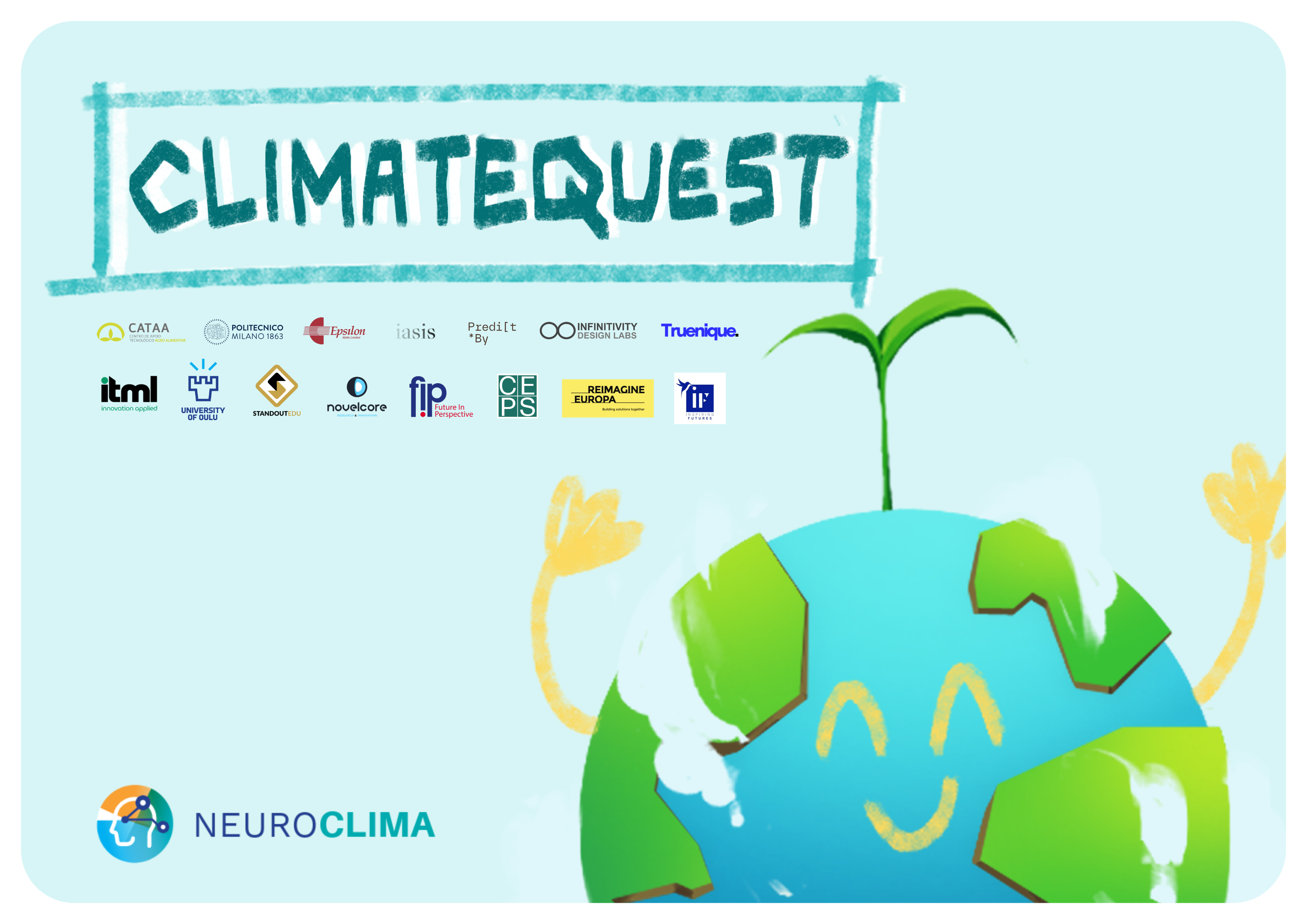
The paper reflects on the design of the NEUROCLIMA Play ecosystem, which includes a suite of interactive learning modules and ClimateQuest, a board game developed to support climate literacy through playful learning experiences.
Designing for a complex topic
Climate adaptation is not an easy subject to translate into playful experiences. It brings together scientific knowledge, environmental risks, human behaviour, social choices, and community responses. At the same time, the people engaging with these topics can differ considerably in age, prior knowledge, interests, and learning contexts.
Within NEUROCLIMA Play, six interactive modules were developed around themes including agro-food, energy, water, disinformation, forest fires, and behavioural change, with content targeted to different learner groups. The challenge was therefore not simply to make climate content more entertaining. It was to think carefully about how playful experiences could make complex issues more approachable while still preserving their educational value.
This meant continually balancing several design considerations: scientific accuracy and playfulness, structure and flexibility, individual learning and collaborative participation, as well as digital interaction and physical play configuration.
From digital learning to shared conversation
The interactive modules provide opportunities for learners to explore climate-related topics through multimedia content, activities, and knowledge checks. ClimateQuest extends that experience into a shared social space. Through the ClimateQuest board game trivia questions, challenge cards, discussion, and collaborative play, learners are encouraged to also engage with climate topics together individually and collectively.
Designing for adaptability
Another important lesson from the work was the need to design for the realities of educators and facilitators. A teacher may have a limited amount of classroom time, a large group of learners, and little preparation time. A youth worker may be facilitating a voluntary community activity with participants who have very different levels of climate knowledge. Another facilitator may have limited access to digital devices.
For this reason, adaptability became an important consideration within the NEUROCLIMA Play ecosystem.ClimateQuest can be played in different modes, individually or in teams, with or without the module-based challenge cards. Facilitators are also provided with supporting guides and editable card templates that allow the experience to be adjusted to different learning objectives and contexts.
The intention is not to prescribe one perfect way of using the toolkit, but to give educators and facilitators enough structure to get started while leaving room for them to respond to their own learners and environments.
Turning R&I Work into Reusable Knowledge
NEUROCLIMA Play reflects the kind of work we do at IDL i.e bringing together educational design, applied research, experimentation, and iterative development to address complex societal challenges. It gives us the opportunity to connect research, design, and implementation in meaningful ways.
Documenting these lessons through the ECGBL paper helps make the knowledge generated through the project reusable beyond its immediate context, contributing to wider conversations on game-based learning and strengthening the evidence base for future educational design and R&I activities.
We are grateful to the wider NEUROCLIMA consortium, whose expertise, feedback, and collaboration have helped shape this work throughout its development. As we prepare to present at ECGBL 2026, we look forward to carrying these lessons into future work and projects.
We are always open to new collaborations. If your R&I project could benefit from expertise in proposal writing, UX research, learning design, playful learning, gamification e.t.c, we would be happy to hear from you and explore how we might work together.
Know more at https://play.neuroclima.eu/


